Showing posts with label One India. Show all posts

Monday, August 20, 2012

Urgent Appeal to Media and Press in the North east

Appeal on behalf of the north east community
                                                                                                                                                              Courtesy photo
This is an urgent appeal on behalf of the north east community living in Bangalore and other cities outside of the north east. As you are aware the situation in many cities has been tense fuelled by rumours of potential violence as well as stray incidents, which have resulted in many people leaving these states and returning to their respective homes in Assam and elsewhere.

As the trains start arriving in Assam and elsewhere there will be an urge to interview people to get a sense of what has been happening and we fear that some of thee stories may be based not on facts but on hearsay and rumour. We urge the media to exercise refrain in the way they carry the stories. The reality of the situation in Bangalore for instance is that community leaders and representatives from the north east and the Muslim community have been hard at work to build trust between these communities and restore peace here. If there any backlash that takes place in Assam as a result of the stories that are carried there is a danger of there being repercussions in cities like Bangalore.

We urge the media to be aware of the important role that they have in trying to bring back trust within all the communities and report without sensationalizing anything which could be used by troublemakers. The media in the north east has played a very vital role in promoting democratic values and ensuring the safety and security of people and we hope that at this critical hour all of you will join hands in promoting a more peaceful and stable future.

Friends and members of the north east community in Bangalore. (Courtesy:kracktivist)

Social Media Networking Sites Misused

Home Minister Expresses Concern  
Union Home Minister Shri Sushil Kumar Shinde has expressed concern to his Pakistani counterpart over the issue of social media-networking sites being misused by elements based in Pakistan to circulate false pictures and stories so as to whip up communal sentiments in India and has sought Pakistan’s full cooperation in checking and neutralizing such elements. Shri Shinde expressed these views when Mr. Rehman Malik, Interior Minister of Pakistan spoke to him today over telephone. This was the first direct contact between the two Ministers.

Shri Shinde thanked Mr. Malik and conveyed his Eid wishes to him and the people of Pakistan. The Union Home Minister expressed the hope that the occasion would herald an improvement in Indo-Pak relations.

The Interior Minister of Pakistan briefly spoke of the pending issues between the two Ministries and re-iterated his commitment to bring the masterminds and perpetrators of the Mumbai terror attack to justice. He assured full mutual cooperation in this matter. Mr. Rehman Malik also invited Shri Shinde to visit Pakistan to sign the revised Visa agreement which has now been agreed to by both sides.

Both concluded the discussion by agreeing to continue the mutual cooperation and to work towards rooting out terrorism in all its form and manifestation.(PIB) 
19-August-2012 16:29 IST

Thursday, August 16, 2012

Bio-Diversity of Western Ghats

Global importance for the conservation of biological diversity
                             Courtesy photo
The Western Ghats are internationally recognized as a region of immense global importance for the conservation of biological diversity, besides having areas of high geological, cultural and aesthetic values. The ecosystems of the Western Ghats include the tropical wet evergreen forests, the montane evergreen forests, moist deciduous forests, etc. There are over 4,000 species of angiosperms (1500 endemic), 332 species of butterflies (37 endemic), 288 species of fishes (116 endemic), 156 species of amphibians (94 endemic), 225 species of Reptiles (97 endemic), 508 species of birds (19 endemic) and 137 species of mammals (14 endemic) reported from Western Ghats.

The Government of India has taken several steps to conserve the rich biodiversity of the Western Ghats. A large number of protected areas comprising national parks, wildlife sanctuaries, tiger reserves and elephant reserves have been established to provide stringent protection to both flora and fauna. Nearly 10% of the total area of Western Ghats is currently covered under the Protected Area category. The largest Protected Area in Western Ghats is the Bandipur National Park in Karnataka. The Silent Valley National Park in Kerala and the Kudremukh National Park in Karnataka are among the important tracts of virgin tropical evergreen forests in India, serving as the home to a healthy population of the globally threatened fauna.

The Western Ghats are important from the standpoint of biodiversity conservation. For the purpose of ensuring protection of biodiversity of Western Ghats, there are some restrictions for setting up of industries in certain ecologically significant areas of Western Ghats, for example, there is a moratorium upto 31st December 2012 for consideration of projects from Sindhudurg and Ratnagiri areas of Maharashtra, and for consideration of mining projects in Goa. There is also a ban on consideration of mining projects in some districts of Karnataka in compliance of Supreme Court Orders dated 29 July, 2011 and 26 August, 2011.

The above information was laid in the Parliament by Minister of State (Independent Charge) for Environment and Forests Shrimati Jayanthi Natarajan.  (PIB photo) 16-August-2012 16:14 IST

Wednesday, August 15, 2012

A colorfulll day for all Indians

The Dignitaries coming out from the Red Fort
The Dignitaries coming out from the Red Fort after the Prime Minister, Dr. Manmohan Singh addressed the Nation on the occasion of 66th Independence Day, in Delhi on August 15, 2012.  (PIB photo)

15-August-2012

A historical day of colors

  Tricolor formation at the Historic Red Fort 
The children in tricolor formation at the Historic Red Fort, on the occasion of 66th Independence Day, in Delhi on August 15, 2012.  (PIB photo)   15-August-2012

Colors of Freedom

Tricolour balloons released in the sky
Tricolour balloons released in the sky after the Prime Minister, Dr. Manmohan Singh’s address to the Nation from Red Fort, on the occasion of 66th Independence Day, in Delhi on August 15, 2012.(PIB photo)       15-August-2012

Tuesday, August 14, 2012

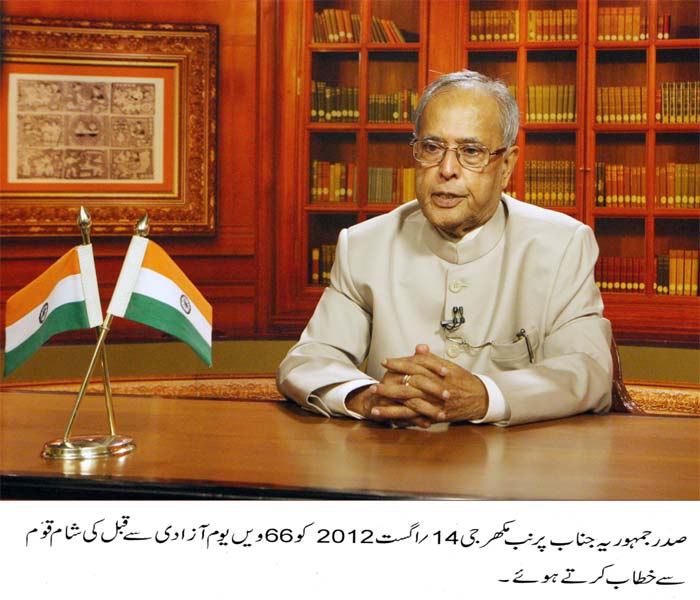
Eve of India’s 66th Independence Day

President’s Address to the Nation on the  on 14th August 2012
           Following is the text of the President of India, Shri Pranab Mukherjee’s address to the Nation on the eve of the 66th Independence Day:
My fellow citizens:
It is a great privilege to address, for the first time, my fellow Indians living within our country and in a hundred corners across the globe, on the 65th anniversary of our independence. Words cannot adequately express my gratitude to the people and their representatives for the honour of this high office, even as I am deeply conscious of the fact that the highest honour in our democracy does not lie in any office, but in being a citizen of India, our motherland. We are all equal children before our mother; and India asks each one of us, in whatsoever role we play in the complex drama of nation-building, to do our duty with integrity, commitment and unflinching loyalty to the values enshrined in our Constitution.
2.         It is important to remember, on Independence Day, that in the age of empires freedom was never given; it was taken. It was won by a generation of giants, led by a mighty man of destiny, Mahatma Gandhi, who fought with selfless, unflinching conviction against the mightiest power in history, with a moral force that transformed political thought and whose reverberations echo in great events all around us today. If the rise of European colonisation began in 18th century India, then the rallying cry of "Jai Hind!" also signalled its end in 1947. The final call to victory, "Jai Hind!" was given by Subhas Chandra Bose, fondly known to every Indian as "Netaji". Pt. Jawaharlal Nehru, Baba Saheb Ambedkar, Sardar Vallabhbhai  Patel, Maulana Abul Kalam Azad, Sarojini Naidu and many others charted the roadmap of independent India. These extraordinary men and women sacrificed their todays for our tomorrows. That tomorrow has come, and there is a question we must ask ourselves: have we honoured the great vision of these stalwarts, as a nation and as a society?

3.         I was a toddler when Netaji, as Rashtrapati of the 51st Session of Indian National Congress in Haripura, on the banks of the river Tapti, reminded us that "our chief national problems are eradication of poverty, illiteracy and disease". His speech echoed through my home, as it did through millions of others. My father was a freedom fighter and through those long years when freedom seemed an illusion, we were sustained by faith in ourselves, in our leaders, in the strength of non-violence, in the courage of Indians liberated from fear. But we knew then, as we do now, that freedom must mean both bread and dreams.
4.         Netaji and Nehruji believed that India could seize the future by an application of synthesis, samyavada, of what might seem on surface to be implacable opposites. They believed that free India would become, by example, an alternative model for a post-colonial world through economic equity and a social revolution inspired by harmony between communities that had been misled into hostility. Propelled by freedom of faith, gender equality and economic justice for all, India will become a modern nation. Minor blemishes cannot cloak the fact that India is becoming such a modern nation: no faith is in danger in our country, and the continuing commitment to gender equality is one of the great narratives of our times.

My fellow citizens:

5.         I am not a pessimist; for me, the glass is always half full, rather than half empty. I would go to the extent of saying that the glass of modern India is more than half full. Our productive working class; our inspiring farmers, who have lifted a famine-wrecked land to food-surplus status, our imaginative industrialist entrepreneurs, whether in the private or public sector; our intellectuals, our academics and our political class have knit together a modern nation that has leapt, within mere decades, across many centuries in economic growth and progressive social legislation.

6.         We cannot appreciate how far we have travelled, until we understand from where we started in 1947. As Jawaharlal Nehru pointed out so often, in his speeches and prose, India was not a poor country when our independence was snatched away. No one, I may add, travels thousands of miles to conquer a poor country. Statistics published by contemporary international scholars are proof for sceptics. In 1750, seven years before the fateful battle of Plassey, India had 24.5% of World Manufacturing Output while United Kingdom had only 1.9%. In other words, one in every four goods on the world market was manufactured in India. By 1900, India had been left with only 1.7% of World Manufacturing Output and Britain had risen to 18.5%. The western industrial revolution was in its incipient stages in the 18th century, but even in this regard India slipped from 7 to 1 in per capita industrialisation in that period, while Britain vaulted from 10 to 100. Between 1900 and 1947 India's economic growth was an annual average of 1%.  From such depths we climbed, first, to 3% growth, and then took a quantum leap forward: today, despite two great international crises that rocked the world and some domestic dips, we have posted an average growth rate of more than 8% over the last seven years.                               
7.         If our economy has achieved critical mass, then it must become a launching pad for the next leap. We need a second freedom struggle; this time to ensure that India is free for ever from hunger, disease and poverty. As my pre-eminent predecessor Dr Sarvepalli Radhakrishnan, speaking from this platform on the 18th anniversary of freedom, said, "Economic progress is one of the tests of democracy."
8.         If progress falls behind rising aspirations, particularly of the young, rage will manifest itself. We are a nation that is becoming younger both in age and spirit; this is an opportunity as well as a challenge. The young thirst for knowledge that will lift their skills; and for opportunity that will put India on the fast track to the first world. They have the character; they need the chance. Education is the seed; and economy is the fruit. Provide good education; disease, hunger and poverty will recede. As I said in my acceptance speech, our motto must be: All for knowledge and knowledge for all. Vision cannot be an open-ended vista; it must be focused on our youth.                     

My fellow citizens:     
9.         Notwithstanding the tremendous pressure of an adverse external environment, our economy today is more resilient and confident. Two decades of steady economic reforms have contributed to improvement in average income and consumption levels in both rural and urban areas. There is new found dynamism in some of the most backward areas bringing them into national economic mainstream. Yet there are several gaps that need to be bridged. Green revolution has to be extended to the eastern region of our country. Creation of high quality infrastructure has to be fast tracked. Education and health services have to reach the last man at the earliest. Much has been done, a lot more remains to be done.

10.       The monsoon has played truant this year. Large areas of our country are in the grip of drought, some others are devastated by floods. Inflation, particularly food inflation, remains a cause of worry, While our food availability remains healthy, we cannot forget the plight of those who made this possible even in a lean year; our farmers. They have stood by the nation in its need; the nation must stand by them in their distress.

11.       I do not believe that there is any inherent contradiction in protecting our environment and economic development. As long as we heed Gandhiji's great lesson: there is sufficient in the world for man’s need but not for man’s greed, we are safe. We must learn to live in harmony with nature. Nature cannot be consistent; we must be able to conserve her bounty during the many seasons of plenty so that we are not bereft during the occasional bout of scarcity.

12.       Anger against the bitter pandemic of corruption is legitimate, as is the protest against this plague that is eroding the capability and potential of our nation. There are times when people lose their patience but it cannot become an excuse for an assault on our democratic institutions.

13.       Institutions are the visible pillars of our Constitution, and if they crack then the idealism of our Constitution cannot hold. They are the interface between principles and the people. Our institutions may have suffered from the weariness of time; the answer is not to destroy what has been built, but to re-engineer them so that they become stronger than before. Institutions are the guardians of our liberty.

14.       The vigilance on our frontiers has to be matched with vigilance within; we must restore the credibility of those areas of our polity, judiciary, executive and legislature where complacency, exhaustion or malfeasance may have clogged delivery. The people have a right to express their discontent. But we must also understand that legislation cannot be wrenched away from the legislature or justice from the judiciary.

15.       When authority becomes authoritarian, democracy suffers; but when protest becomes endemic, we are flirting with chaos. Democracy is a shared process. We all win or lose together. Democratic temper calls for dignity of behaviour and tolerance of contrary views. Parliament will live by its own calendar and rhythm. Sometimes that rhythm sounds a bit atonal; but in a democracy there is always judgement day, an election. Parliament is the soul of the people, the “Atman” of India. We challenge its rights and duties at our peril.


16.       I say this not in a spirit of admonition, but as a plea for greater understanding of the existential issues that lurk behind the mask of the mundane. Democracy is blessed with a unique opportunity for redress of grievances through the great institution of accountability - free elections.

17.       Old fires that threaten the stability of our nation have not been fully doused; the ash continues to smoulder. It is particularly painful for me to witness the violence in Assam. Our minorities need solace, understanding and protection from aggression. Violence is not an option; violence is an invitation to greater violence. Concrete attempts have been made to heal the wounds of Assam, including the Assam accord conceived by our young and beloved former Prime Minister Rajiv Gandhi. We should revisit them, and adapt them to present conditions in the spirit of justice and national interest. We need peace for a new economic surge that eliminates the competitive causes of violence.

18.       It is a fact of our geopolitical environment that some problems transcend borders. SAARC was created 27 years ago to find solutions through dialogue, and by mutual cooperation create the rapid economic growth that is the only long-term answer to problems like migration and uneven development. SAARC must acquire vigour to fulfil its mandate.
19.       The SAARC should be a major instrument in the common war against terrorists. Great success is possible by international cooperation. All SAARC nations must cooperate to bring to justice those who believe in mayhem against innocents. There is no other way towards peace on the subcontinent.
20.       I am proud of our brave armed forces and our valiant police forces, who have done so much, at such great personal risk, to curb this menace of terrorism. It is their vigilance which has prevented more havoc. If we sleep in peace it is because they are awake and vigilant in the desolation of desert and mountain and forest; and in the vast loneliness of the seas. I salute their commitment and their patriotism. It is heartening that the armed forces not only guarantee our peace, but also produce medal winners at Olympics. I congratulate all who have done their nation proud at the recently concluded Games, by winning as well as by participating. The number of trophies may not be too large but it is a remarkable improvement upon the last count, Four years later, when I hope to address you again, I am sure, we will celebrate a medals spring.

My fellow citizens:

21.       If there is one man in history whose name is synonymous with peace, then it is Gandhiji, the architect of our independence. India is a land of plenty inhibited by poverty; India has an enthralling, uplifting civilization that sparkles not only in our magnificent art, but also in the enormous creativity and humanity of our daily life in city and village. When Indira Gandhi reached for the stars, she believed that this would be within the grasp of India in just another generation. But there is neither a present nor a future, except in a climate and culture of national unity and brotherhood.


My fellow citizens:
Let us leave behind the way of hatred, violence and anger;

Let us put aside our petty quarrels and factions.

Let us work together for our nation with the devotion of a child towards a mother.

Let us repose our faith in this invocation from Upanishads:

May God Protect us.

May God Nourish us.

May we Work Together with Vigour and Energy.

May our Studies be Brilliant.

May there be no Hostility amongst us.

May there be Peace Peace Peace.

Peace must be our ideology, progress our horizon.
Jai Hind!

  14-August-2012 19:25 IST
                                                                                   

President Of India Greets the Pakistan

President Of India Greets the People and the Government of Pakistan on the Occasion of Independence Day of Pakistan
The President of India, Shri Pranab Mukherjee has greeted the people and the Government of Pakistan on the occasion of their Independence Day.

In a message to HE Mr. Asif Ali Zardari, the President of the Islamic Republic of Pakistan, the President has said, “On behalf of the people and the Government of India, I have the pleasure of conveying our greetings and felicitations to the people and the Government of Pakistan on the occasion of your Independence Day.

It gives me pleasure to note the progress in bilateral di****alogue, a reflection of the strong desire of our people for peace and harmony. I am confident that the success of our sustained efforts would result in mutually beneficial cooperation for our peoples to realize the shared goals of peace, progress and prosperity.”   (PIB)  (14-August-2012)  14-August-2012 19:48 IST     ****